
Loading...
Loading...

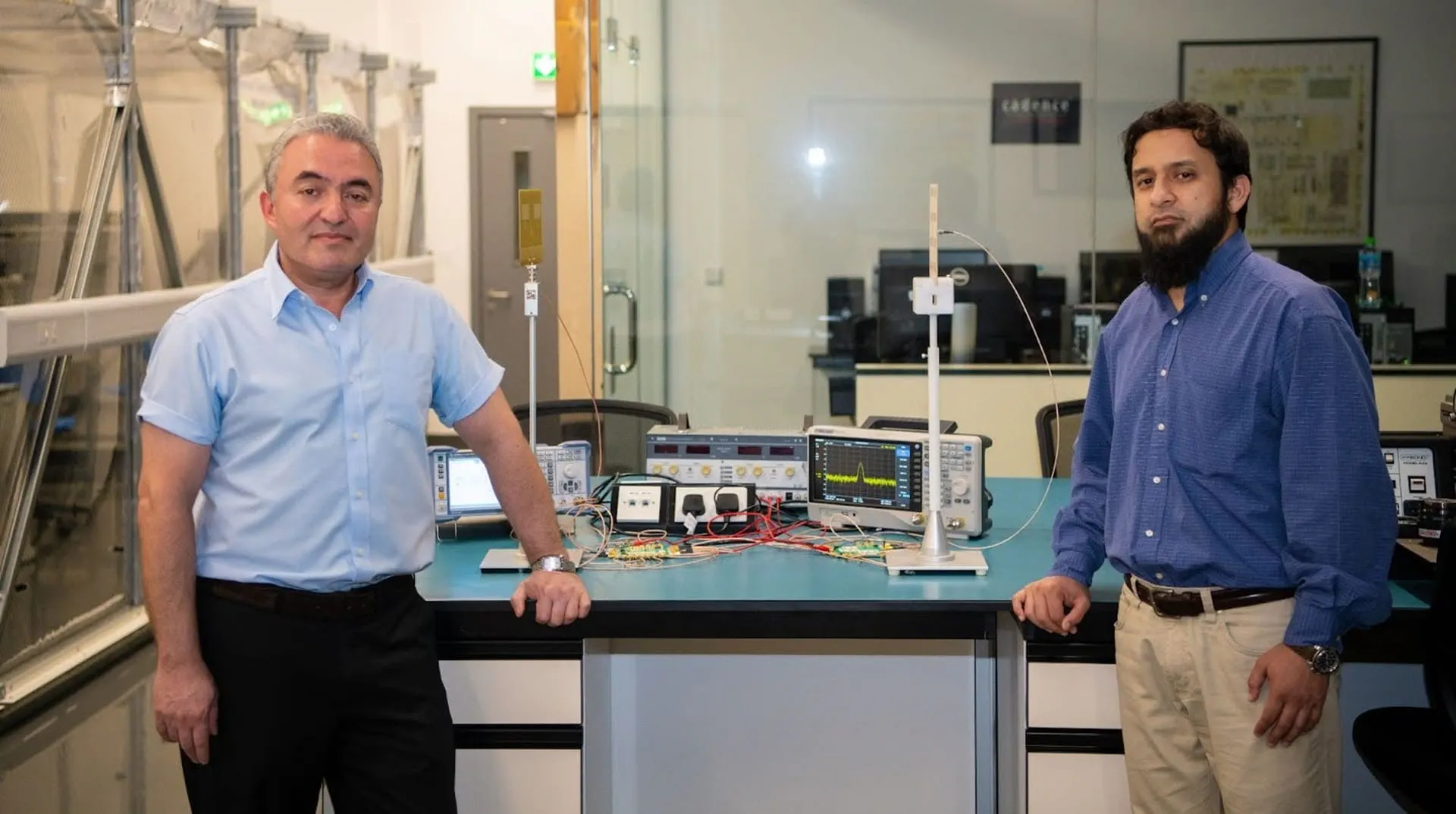
The innovation provides exceptional precision and a wide dynamic range in a portable design, opening new opportunities in transportation safety, civil protection, defence, and healthcare sectors. Developed by Professors Dr Lutfi Albasha and Dr Hasan Mir, the patented radar uses a signal-processing architecture capable of detecting subtle motion differences that conventional systems often miss. Its low-power, compact design offers high accuracy, extended range, and reduced size and energy loss, representing a significant advancement in portable, intelligent radar technology.
Dr Albasha explained that the system can detect and classify small or low-flying objects such as drones, as well as human motion and structural vibrations. The radar is versatile, capable of connecting to networks, and effective in all weather and light conditions, while also respecting privacy—making it suitable for a broad range of civil applications.
The radar was co-developed with former AUS master’s student Mansour Taghadosi, who contributed to the PCB design. The concept and signal-processing framework were devised by Dr Albasha and Dr Mir. The system supports networked operation, allowing multiple units to share and fuse data to create scalable wide-area detection networks.
The idea originated from collaboration with the UAE Army and Civil Defence, who encountered difficulties in detecting small drones and low-altitude aerial objects in complex urban and desert environments. These discussions inspired the development of a compact, energy-efficient radar capable of differentiating between drones, people, and vehicles in cluttered, low-visibility conditions.
AUS laboratory tests showed that the signal-to-noise ratio (SNR) performance matched—or exceeded—that of larger and more costly radar systems. Dr Mir observed that the radar reliably detected small, low-flying objects with high precision, even in environments with considerable noise or visual obstruction.
The radar has potential applications in drone monitoring, airspace safety, civil defence, emergency response, transportation, infrastructure surveillance, wildlife tracking, environmental observation, and healthcare, where it can detect breathing or movement without cameras, providing a private and non-intrusive solution.
The team is in discussions with UAE organisations to explore development pathways and real-world applications. They are seeking funding and a dedicated space to build the full system, including antenna arrays, to conduct large-scale field trials. The radar has been officially patented in both the USA and UAE, reinforcing AUS’s leadership in applied research and intelligent sensing technologies.

 For an optimal experience, please
rotate your device to portrait mode.