
Loading...
Loading...

The inaugural FIFA World Cup in Uruguay in 1930 was unlike any other. Four European teams arrived by ship, the two finalists disagreed over the match ball, the referee feared armed spectators entering the stadium, and one of the goalscorers played with only one arm.
The entire opening tournament was held in Montevideo, the capital of Uruguay. A public holiday was declared after “La Celeste” became the first team to win the World Cup title, defeating fierce rivals Argentina 4–2 in the final.
At its first meeting in Paris in 1904, FIFA announced its right to organise a global football competition, but it was not until the 1920s that the idea gained real support.
Football at the 1924 Paris Olympic Games proved hugely popular, with more than 40,000 spectators watching Uruguay defeat Switzerland in the final. When the British associations, with their professional leagues, refused to participate because of disputes over amateur player regulations, it became clear that the time had come for a separate international football competition.
In 1928, FIFA decided to hold the tournament every four years, beginning in 1930.
The first edition took place between 13 and 30 July 1930, only months after the Wall Street Crash. Uruguay’s bid relied on its Olympic gold medals in 1924 and 1928, as well as celebrations marking the centenary of its independence.
For the occasion, the massive Estadio Centenario was built with a capacity of 90,000 spectators. However, heavy winter rains delayed construction, meaning two alternative venues were initially used.
After Uruguay was selected to host the first tournament, attention turned to participating teams. Invitations were sent to all FIFA member nations, but no qualifying rounds were held because organisers failed to secure the planned 16-team field.
Two months before the tournament, FIFA President Jules Rimet intervened personally to persuade European nations to participate.
Some European countries were unhappy with Uruguay hosting the event because of the long Atlantic crossing. Eventually, only four European teams took part: France, Belgium, Romania and Yugoslavia. British teams were absent because they were not FIFA members until 1950.
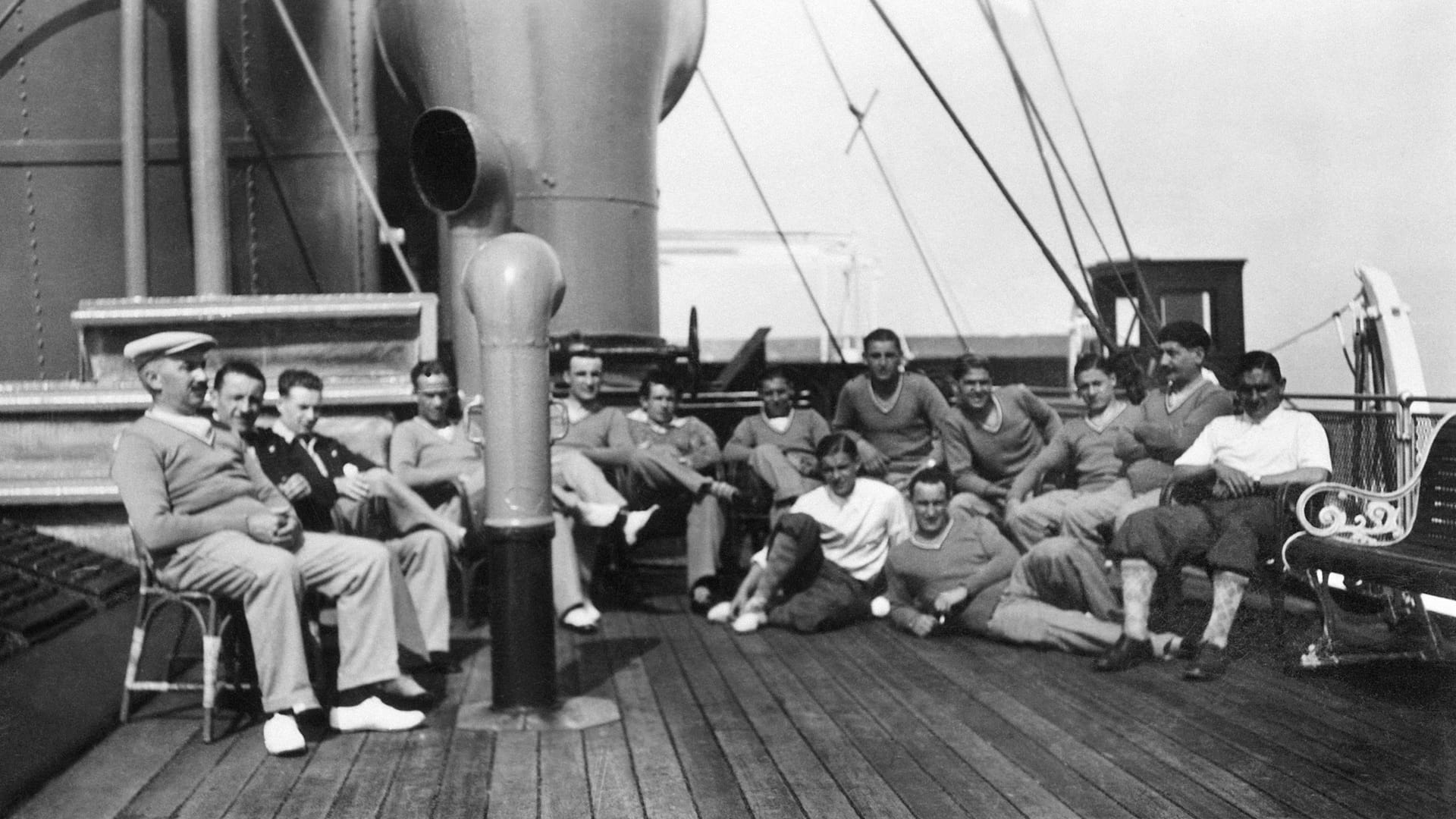
Rimet travelled carrying the World Cup trophy in his suitcase, accompanied by his daughter and three referees. France, Belgium and Romania sailed aboard the famous Conte Verde, while Yugoslavia travelled on the Florida. Egypt had been expected to join in Marseille but missed the journey after storms disrupted its Mediterranean crossing.
Romania’s squad, selected personally by King Carol II, boarded in Genoa on 20 June. France joined from Villefranche-sur-Mer and Belgium from Barcelona. The ship stopped in Lisbon, Madeira and the Canary Islands before collecting Brazil’s team in Rio de Janeiro and finally arriving in Montevideo on 4 July — nine days before the tournament began.
Romania captain Rudolf Wetzer later said:
“The seats were very uncomfortable. Our bones hurt, but it was worth it.”
Nine South American nations also took part. The 13 participating teams were divided into four groups, with only group winners advancing to the semi-finals.
France’s Lucien Laurent earned a place in history by scoring the first goal in World Cup history against Mexico in the 19th minute.
Laurent later said:
“After my goal — the first of the tournament and my first for France — we congratulated one another, but we did not celebrate like players do today.”
Argentina’s Guillermo Stábile finished as top scorer with eight goals despite starting the tournament on the bench. Uruguay coach Alberto Suppici was only 31 years old when he led his side to glory.
South American teams dominated the tournament.
Argentina defeated the United States 6–1 in the semi-finals, while Uruguay beat Yugoslavia by the same score.
Uruguay won the final 4–2 in front of approximately 68,000 spectators after trailing 2–1 at half-time. The victory repeated Uruguay’s triumph over Argentina in the Olympic final two years earlier.
Before the final, many Argentine supporters were stranded on boats on the River Plate because of heavy fog.
Organisers also ordered spectators to surrender weapons. Belgian referee John Langenus feared tensions between rival fans could escalate.
Around 1,600 weapons were confiscated.
Langenus, who also worked as a correspondent for German magazine Kicker, remained nervous and insisted on having a boat ready at the harbour in case he needed to leave quickly.
He even agreed to use two different match balls — one chosen by each finalist — to settle a disagreement between Uruguay and Argentina.
Uruguay’s fourth goal came in the 89th minute through Héctor Castro, nicknamed El Divino Manco (“The Divine One-Armed Man”).
The 25-year-old had lost part of his arm in an accident involving an electric saw when he was 13.
Argentina’s Francisco Varallo, who died in 2010 aged 100, later explained his team’s collapse in the second half:
“I played with an injured knee. We were reduced to ten men, then another player got injured, then another. But honestly, they beat us fairly. What could we do? Eight against eleven had no chance.”
Uruguay captain José Nasazzi, known as “The Terrible One”, then lifted the first World Cup trophy, designed by French sculptor Abel Lafleur.

 For an optimal experience, please
rotate your device to portrait mode.